Best AI Agent for Stock Trading: 6 Tools Worth Testing in 2026
22 tháng 9, 20268 phút đọc
Finding the best AI agent for stock trading is less about choosing the tool with the loudest return claim and more about deciding what work you want the software to do. Some agents build and execute rules, some prepare orders for approval, and others only research markets or generate signals.
This comparison focuses on six products with real agent-like workflows for stocks. It uses current official product documentation, separates execution from analysis, and does not rank tools by hypothetical performance. AI does not remove market risk, and none of these products can guarantee a profitable trade.
AI agent
Best for
Can place or automate trades?
Composer
Building and running rule-based stock and ETF strategies
Yes, after you review and activate a strategy
Capitalise.ai
Writing entry and exit rules in plain English
Yes, through supported broker or exchange connections
Trade Ideas Holly AI
Intraday stock ideas with entries, stops, and targets
Manual, one-click, or automated workflows depend on Brokerage Plus setup
Interactive Brokers IBot
Researching and preparing orders inside an established brokerage
It prepares orders; you review and submit them
TrendSpider Sidekick
Chart analysis, scanning, alerts, and multi-symbol research
No, it does not place or modify trades
Tickeron AI Robots
Following robot-generated stock and ETF trade ideas
Varies by robot and brokerage workflow; paper testing is available
1. Composer
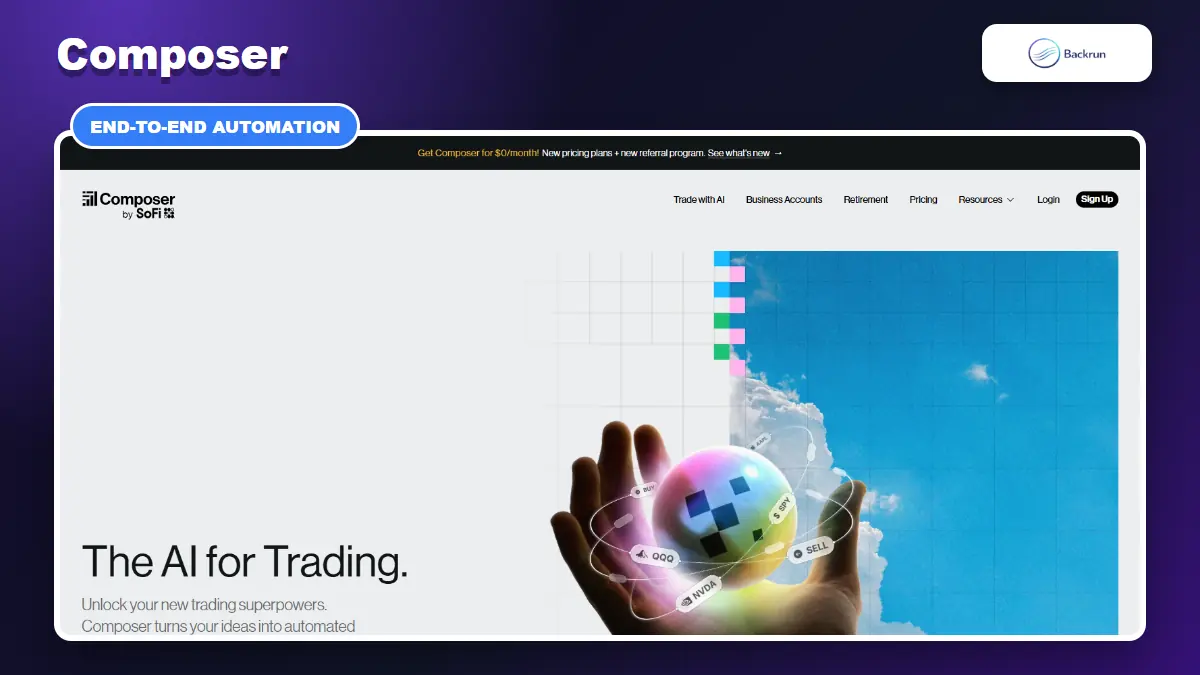
Composer combines natural-language strategy creation, backtesting, and automated execution in one product.
Best for: investors who want one environment for idea generation, backtesting, editing, and automated execution.
Composer is the closest option here to an end-to-end stock trading agent. You describe a strategy in natural language, the AI converts it into a structured “symphony,” and you can inspect the holdings, logic, risk statistics, and backtest before deciding whether to run it. Composer's official documentation states that the user reviews and confirms a strategy before automated rule-based trading begins.
The main advantage is continuity. You do not have to move an idea from a chatbot into a separate backtester and then rebuild it in a broker. The same product can create, edit, backtest, and execute strategies for supported stocks and ETFs. That makes Composer a strong candidate for the best AI agent for stock trading when automation matters more than intraday discretion.
What it does well: no-code strategy construction, transparent logic, backtesting, scheduled rebalancing, and execution.
What to verify: account eligibility, supported securities, trading windows, tax impact, and the difference between a backtest and live fills.
Main limitation: its automation still follows the strategy you approve. A coherent rule is not automatically a sound investment thesis.
Start with a small, interpretable strategy. If you cannot explain why every condition and asset exists, do not let the system trade it.
2. Capitalise.ai
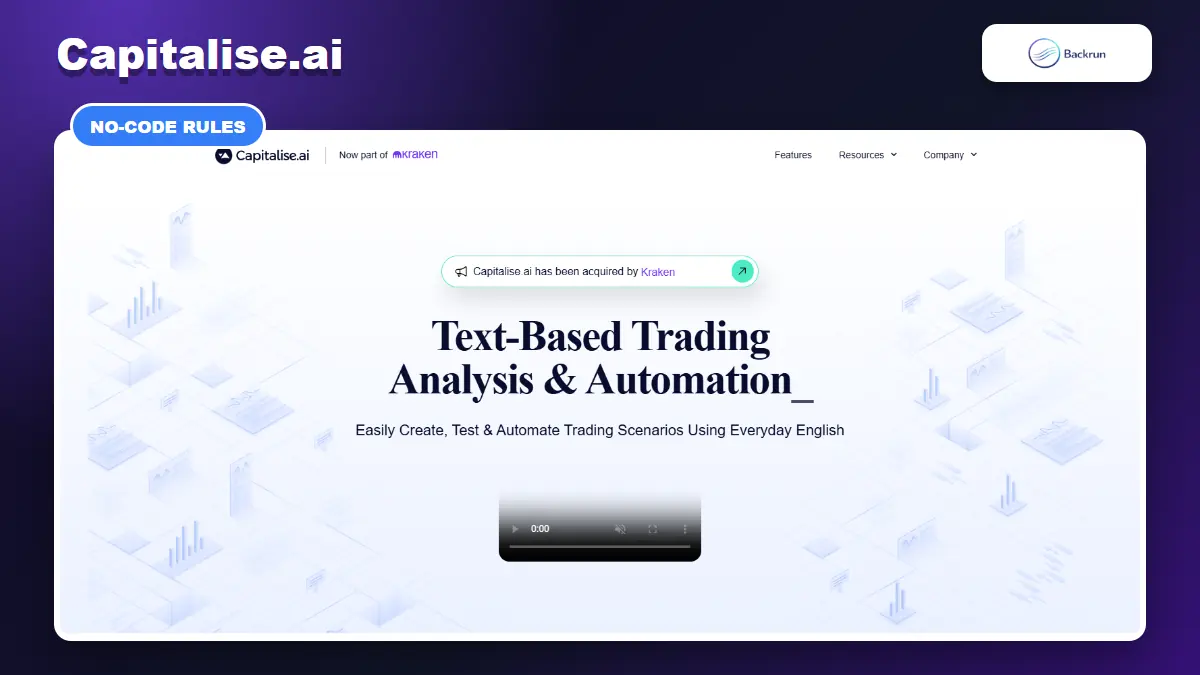
Capitalise.ai translates plain-English entry and exit rules into automated strategies through supported brokers and exchanges.
Best for: traders who already have clear entry and exit rules but do not want to code an algorithm.
Capitalise.ai turns everyday English into automated trading scenarios. A rule can combine prices, technical indicators, timing, and other supported conditions, then be backtested, simulated, monitored, or activated through a compatible broker or exchange. Its help center describes live strategies that monitor conditions and trigger automatically according to the user's logic.
This makes Capitalise.ai different from a stock picker. It does not need to invent a trade for you. Its strongest use case is translating a trading plan you already understand into a machine-readable workflow that can monitor the market consistently.
What it does well: plain-English rules, backtesting, simulation, alerts, and broker-connected execution without custom code.
What to verify: whether your broker, region, asset, order type, and indicator are supported before designing the strategy.
Main limitation: ambiguous language can create a rule that behaves differently from what you intended.
Before going live, rewrite every condition so it has an exact trigger, timeframe, position size, exit, and failure rule. Simulate the strategy first and compare the generated logic with your written plan.
3. Trade Ideas Holly AI
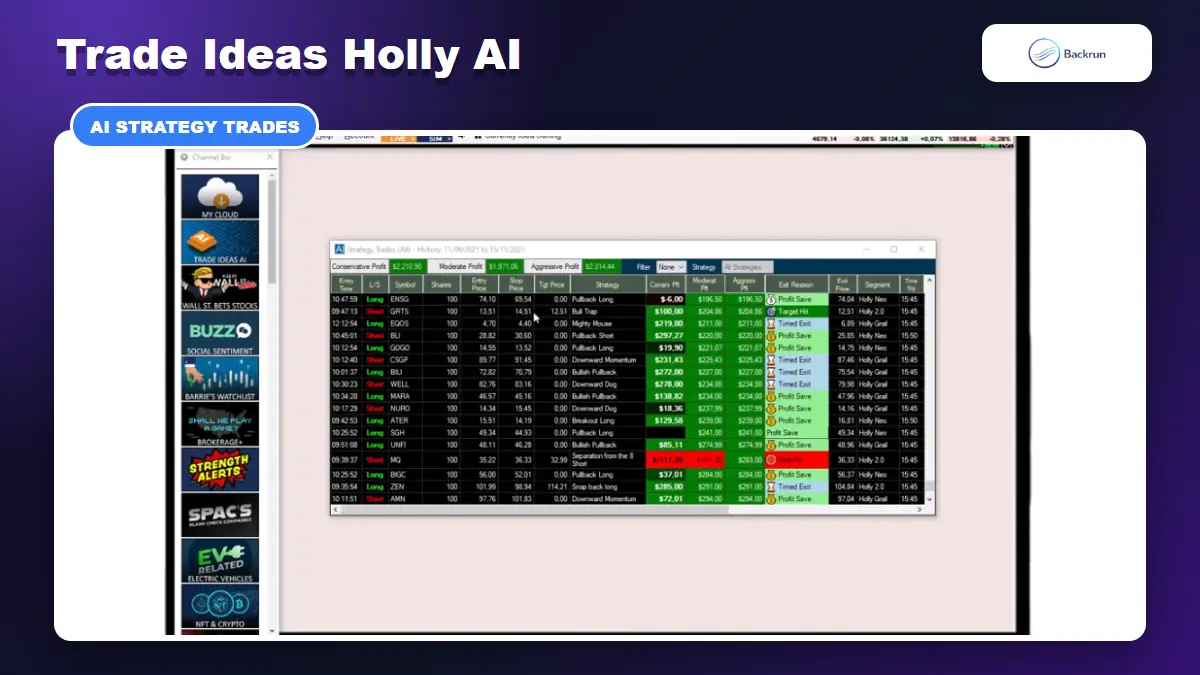
Holly AI focuses on intraday stock suggestions with entries, stops, and targets rather than open-ended chat.
Best for: active U.S. stock traders who want intraday ideas with defined entries, stops, and targets.
Holly AI is Trade Ideas' virtual trading assistant. It evaluates a library of algorithms and presents real-time stock suggestions during the trading day. The official guide says Holly's signals include entry prices, stops, and targets, and that she closes intraday rather than holding positions overnight.
Holly is therefore more of a specialized signal agent than a general chat agent. Trade Ideas' Brokerage Plus module can connect the workflow to its simulator or participating brokers. Depending on configuration, traders can inspect a signal, send an order with one click, or automate selected strategies. That flexibility is useful, but it also means users must understand which part is Holly's signal and which part is their own execution template.
What it does well: focused intraday scanning, pre-defined trade plans, and integration with a professional stock-trading workspace.
What to verify: broker support, subscription requirements, slippage, liquidity, and whether auto-trading is enabled for the exact strategy.
Main limitation: Holly's own algorithms are not customizable, and fast intraday signals can be difficult to reproduce at the displayed price.
Evaluate Holly with the simulator before connecting real capital. Track fills, spread, slippage, and rule adherence rather than only the published strategy result.
4. Interactive Brokers IBot
IBot can research markets and prepare order tickets from plain-English instructions while keeping final approval with the trader.
Best for: Interactive Brokers customers who want to research markets and prepare orders using natural language.
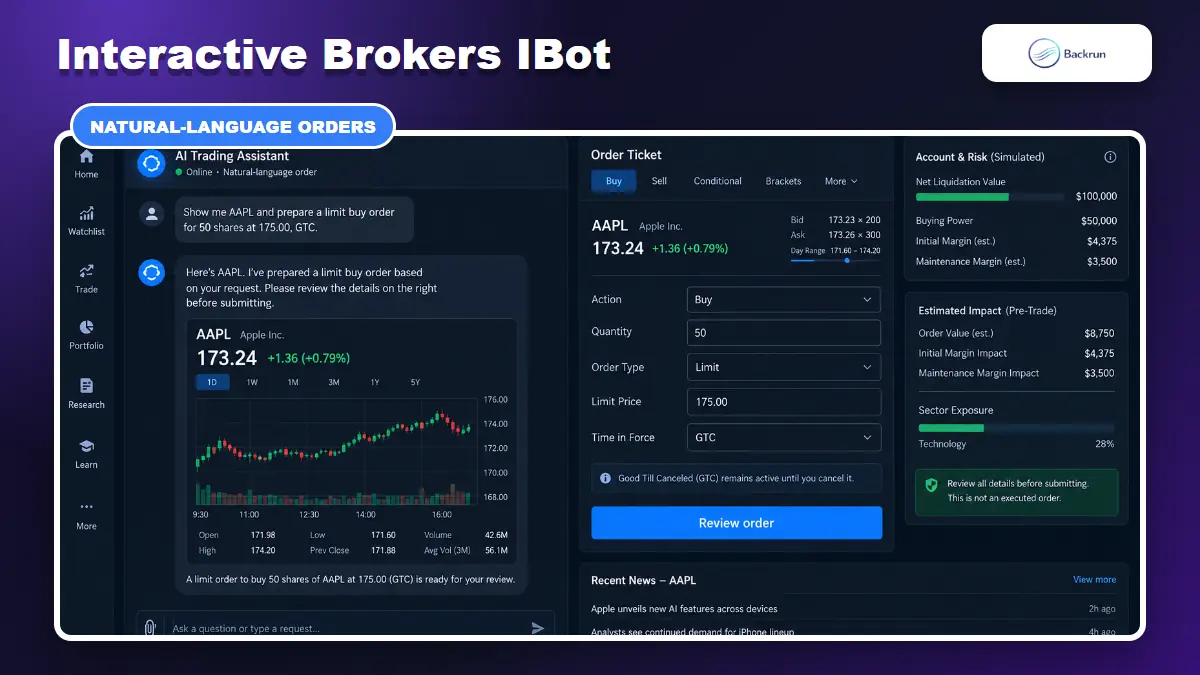
IBot connects natural-language requests with Interactive Brokers' market data, account tools, scanners, charts, and order tickets. A trader can ask for market movers, view an option chain, check account metrics, or describe an order in plain English. IBot then prepares the relevant action inside the brokerage interface.
The control model is important: IBot is not an unsupervised trading robot. Interactive Brokers says the order ticket is prepared for review before submission. That makes it a practical trading agent for reducing interface friction while preserving a human confirmation step.
What it does well: account-aware research, natural-language order entry, scanners, positions, charts, and cross-asset brokerage workflows.
What to verify: order type, quantity, price, time in force, account, currency, and margin impact on every generated ticket.
Main limitation: it accelerates commands but does not decide whether a trade is suitable for you.
IBot may be the best AI agent for stock trading for an experienced IBKR user who values control more than hands-free automation. The agent reduces clicks; the trader still owns the decision.
5. TrendSpider Sidekick
Sidekick can analyze charts, run scans, create alerts, and coordinate multi-symbol research, but it does not place trades.
Best for: traders who need an agent for research, scanning, alerts, chart analysis, and indicator development.
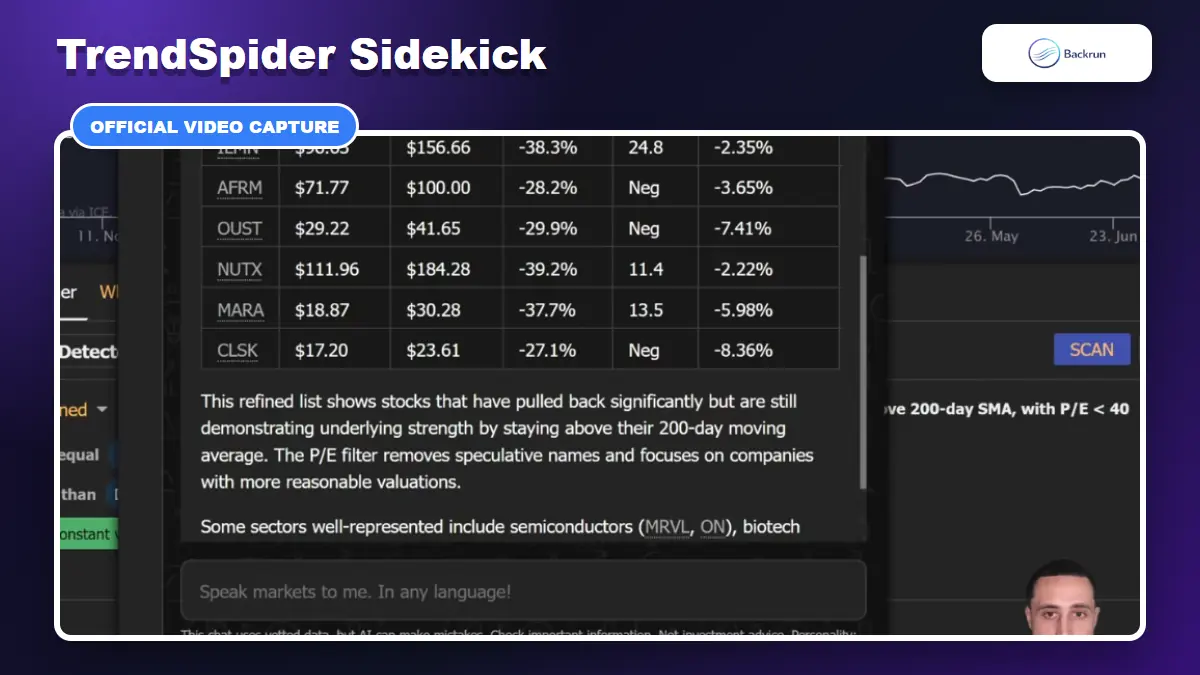
TrendSpider Sidekick is explicitly positioned as an agentic market analyst. It can inspect charts, query market and fundamental data, run scans, analyze backtests, create alerts, and help write custom indicators. Its deep-research workflow can distribute multi-symbol analysis across sub-agents and return a consolidated result.
Sidekick belongs on this list even though it does not execute trades. TrendSpider's current help documentation states that Sidekick cannot place, modify, or close positions. Its value is upstream: it reduces the research and platform work needed to turn an idea into a defined setup.
What it does well: chart-aware analysis, live scans, alert creation, fundamental comparisons, SEC filing research, and indicator coding.
What to verify: the data source, timeframe, universe, ranking rule, and any assumptions used in a generated scan.
Main limitation: it can produce an impressive analysis without providing trade execution or personalized advice.
Use Sidekick to challenge a thesis, not merely confirm it. Ask for counterarguments, invalidation levels, missing data, and conditions that would make the setup fail.
6. Tickeron AI Robots
Tickeron offers stock and ETF robots with trade ideas, paper-trading workflows, and performance histories that still require careful validation.
Best for: traders who want to browse specialized stock and ETF robots, inspect their signal history, and test ideas in a paper environment.
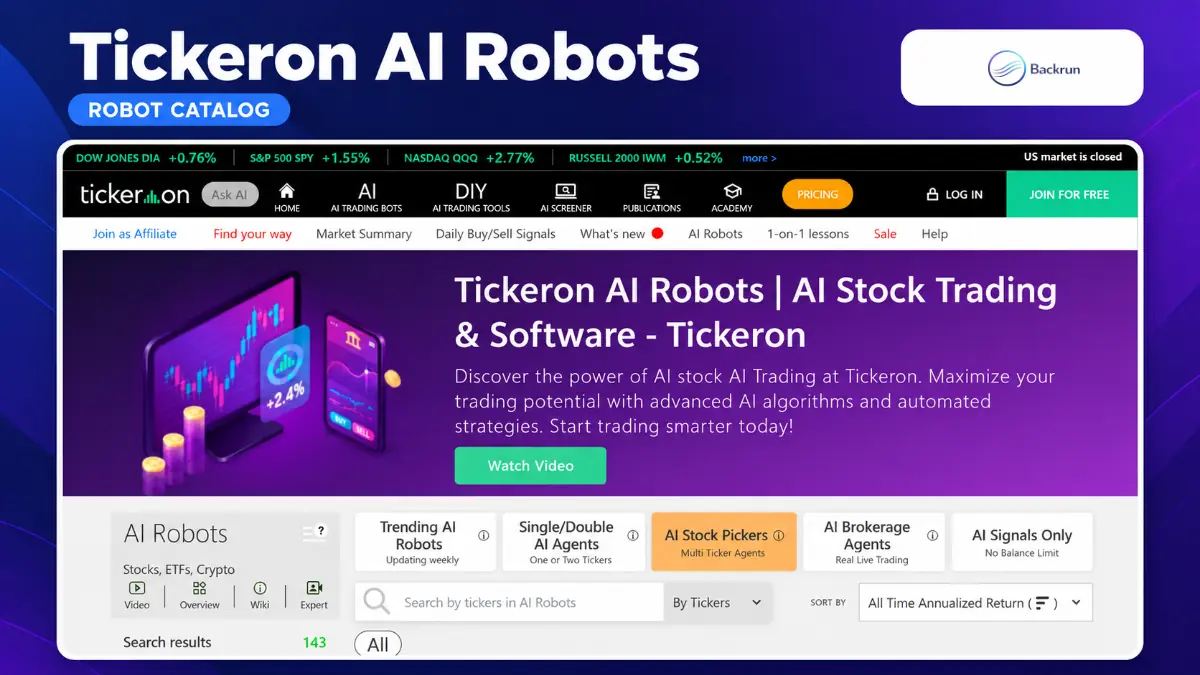
Tickeron AI Robots covers a large catalog of single-agent and multi-agent systems for stocks, ETFs, and other assets. Robots publish entries and exits or real-time ideas, and Tickeron provides filters for timeframe, asset class, analysis type, volatility, and agent type.
The breadth is useful, but it creates a selection problem. A robot with attractive historical statistics is not automatically the best fit for the next market regime. Tickeron's own pages include risk disclosures and distinguish historical, simulated, and live contexts. Users should make the same distinction when comparing robots.
What it does well: a broad agent catalog, transparent trade histories, paper-trading workflows, and strategies for different timeframes.
What to verify: whether results are backtested, simulated, paper, or live; subscription terms; liquidity; trade frequency; and brokerage support.
Main limitation: choosing from many robots can encourage performance chasing, especially after a strong period.
Which agent should you choose? Composer is the most complete create-to-execute workflow; Capitalise.ai is strongest for automating your own written rules; Holly targets intraday signal traders; IBot is best for brokerage control; Sidekick is the research specialist; and Tickeron offers the broadest robot marketplace. The safest way to select the best AI agent for stock trading is to paper-test one clearly defined workflow, record live-like fills and failures, and only then decide whether the automation saves time without hiding risk.